
Dialectics in Keynes - Contradiction in the Divine
The failure of money-capital as a measure and Keynes's legacy


Dialectics in Keynes - Contradiction in the Divine
To be always acquainted with the Rule and Arithmetical Proportion which things bear among themselves and with Gold, it were necessary to look down from Heaven, or some exalted Prospect upon all the things that exist, or are done upon the Earth; or rather to count their Images reflected in the Heavens as in a true Mirror. Then we might cast up the Sum and say, There is on Earth just so much Gold, so many Things, so many Men, so many Desires: As many of those Desires as any thing can satisfy, so much it is worth of another thing, so much Gold it is worth.
Nearly a century ago, capitalism as it was traditionally understood collapsed. The Great Depression of 1929–33 was not a regular cyclical downturn; it marked what some have argued was the effective collapse of “production based on exchange value” – in other words, the end of classical commodity-money capitalism. Jehu has pointed out that this period saw the breakdown Marx had anticipated: gold, the money-commodity underpinning exchange value, ceased to function as the stable measure of value, and with it the gold-standard world unravelled. In Marx’s terms, production based on commodity money –the gold standard– had reached its historical limit. From the early 1930s on, capitalism could no longer be moored to exchange value in the old way; it had to be fundamentally reorganised. In this reorganisation, money itself took on a new role: it became a unique, peculiar form of capital. The aim for this post is to explore this transformation with the method that has been use thus far, notably keeping the overlap of Marx and Hegel close by. What is discussed as a focal point is the historical development of John Maynard Keynes’s monetary theory, and how Keynes’s conception of money develops through A Treatise on Money and General Theory implicitly grasped money as capital, and how this relates to value and distribution under historically specific conditions, which also allows for a look at the present.
Along the way, the goals is to clarify what I think are common misunderstandings of Keynes (on the gold standard and on effective demand) and engage with this work through Hegel’s and Marx’s insights into contradiction. It is going to be a longer post; parts might be rewritten in the future. It also could be noticeable that some points made by Jehu and others will be repeated – please note I do not intend to present them as novel in such cases and try to link to where I originally found (a similar) statement. For some readers familiar with Marx and or Keynes, some content will be not new information at all – in. similar vein, these examples are not a claim on novelty, rather they are supportive of an overarching point. Digressing, we might start with the collapse of 1929 and Keynes’s response.
1929: From Gold Collapse to Money-Capital
The year 1929 stands as a historical hinge. With the financial crash and the Great Depression, the classical gold-standard world ended. Production based on exchange value – meaning the system where commodities trade at values anchored in a gold money – broke down. Gold could no longer serve as the impartial “hoard of value” regulating the system; governments were forced off gold and into uncharted territory of fiat money and state intervention. Marx had written that it was initially an accident which particular commodity became the universal money. Gold had won that role historically, but its rule proved precarious and short-lived. Indeed, Marx observed that while credit and paper money could not ultimately detach from a gold base, even a gold-based system was not immune to collapse[4]. The Depression confirmed this: the gold standard’s contradictions – its inflexibility amid crisis, its tethering of national economies to a scarce metal – led to its demise. By 1933, commodity money was effectively dead, and with it the “old” capitalist paradigm – that is to say, how political economists at the time viewed it –went into cardiac arrest.
Though secondary to this topic, it is noteworthy to stress that the implementation and downfall of the gold standard is heavily correlated with the growth and downfall of the British Imperialist empire, which institutionalised it in 1821. A recommended read is Globalizing Capital (2019) by Barry Eichengreen. It should be no surprise that Ricardo advocated for it. A similar pattern arose long before too with silver and the Spanish empire.
Going back to 1929; Keynes was acutely aware of these events. Long before 1971 (when the last vestiges of gold backing for currencies were “removed” by Nixon), Keynes had deemed the gold standard a “barbarous relic” and pushed for its abolition. As early as 1923, he argued that treating money as a gold-linked commodity was a dangerous farce constraining economic policy. In his view, clinging to gold was senseless when value creation in the modern economy depended on workers earning wages and spending them. In a purely pragmatic, though not very critical sense, the gold link only hampered governments’ ability to fight unemployment and collapse. Keynes got his wish: the interwar and WWII years saw gold convertibility virtually suspended, and postwar Bretton Woods only semi-formally restored it. By 1971 even that tenuous gold link dissolved, as the U.S. halted dollar-gold convertibility completely. Yet mainstream economics, and arguably Keynes is guilty of this too, often shrugged this off – treating gold as irrelevant all along. If the gold standard was always a mere “relic,” one might ask, what did its final dissolution signify? We will return to that question. Suffice it to say here that Keynes recognized something crucial: once capitalism entered its 20th-century phase, state-backed money (fiat currency) would have to play a central, active role in sustaining economic life. Money was no longer just a passive medium or measure; it was becoming the very lifeblood of the system – a form of capital in its own right.
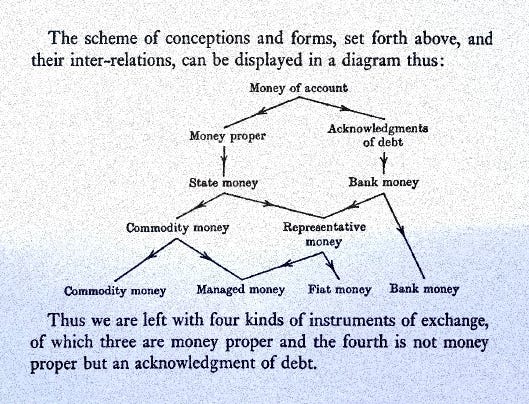
Excerpt from Treatise on Money. Keynes’s account of forms of money, already pre-General Theory, were markedly different from other economists.
In the wreckage of 1929, then, a new regime emerged. Though “capitalism” as such did not disappear; rather it mutated into a system which was perfectly attuned to enact virtually all Counteracting Influences. The collapse of exchange-value-based production cleared the ground for what Keynes would call a “monetary production economy.” In such an economy, money itself organizes production and distribution, backed by state authority rather than gold. Keynes’s work in the 1930s can be read as the theory of this new regime. He effectively asked: How do we stabilize and guide a capitalist economy after its traditional value anchor (commodity money and laissez-faire) has broken down? His answer was to reconceptualize money as a very specific form of capital – the key strategic factor in driving output and employment. This answer is developed most fully in The General Theory of Employment, Interest and Money (1936), but its seeds are visible in his earlier Treatise on Money (1930) and essays of the 1920s. Keynes observed that in the modern economy, money “enters into the economic scheme in an essential and peculiar manner”, such that changing expectations about the future (i.e. uncertainty) can drastically affect current output and jobs. Unlike classical theorists who treated money as a neutral veil over barter, Keynes insisted that we must analyse a monetary economy – one in which production begins with money and aims to end with more money. In fact, in lectures around 1932, Keynes explicitly invoked Marx’s famous formula M–C–M′ (Money → Commodity → More Money) to describe the entrepreneurial form of capitalism. This was a remarkable crossing of wires: Keynes, a liberal economist, drawing on Marx to characterize the system he was studying. Perhaps more than is usually acknowledged, Keynes was well-aware of the Labour Theory of Value, and Marx. A great deal of insight in this regard was provided by L. Randall Wray (1999); where it is argued that liquidity preference theory should be interpreted as a theory of value proper, wherein the role of labour is indispensable.
What Keynes grasped is that after 1929, something had to step forward as the organizing principle of capitalism, because the old self-regulating market mechanism had failed. The answer, effectively fiat money, meant that money became the principle organising force of the economy and society: all domains of an economy in their most general form as discussed by Marx in Grundrisse: production, distribution, exchange, and consumption were now processes which were overdetermined precisely because money could uniquely carry the overdetermined task of denominating what was established in the previous post:
Money became this measure – for now. Money was no longer just a unit of account or a circulating medium – it became, in effect, the master commodity, the form in which capital presents itself; not in the naïve sense that a stack of money is “capital”; rather, if capital expresses itself as embedded future labour, this expression takes place through the measure of money. Piketty should take note of this nuance.
Capital according to Piketty, apparently.
In The General Theory’s preface, Keynes describes his work as a study of the forces determining output and employment as a whole, in which “money enters in an essential and peculiar manner”. He immediately defines his object of study as a “monetary economy… one in which production begins with money on the expectation of ending with more money later”. Under conditions of uncertainty about the future, money is the coordinating mechanism: it links present decisions with future outcomes, since production takes time and entrepreneurs advance money now in hopes of returns later. Keynes contrasts this explicitly with a mythical “real-exchange” or barter economy. In a pure barter world, Say’s Law would hold and every sale would fund a purchase; but in what Keynes calls the “entrepreneur economy”, there is a fundamental division between capitalists (who advance money and hire labour) and workers (who receive wages and spend them). This structural reality – wages at the centre of demand – means that effective demand (the total spending on output) is not automatically sufficient. It depends on how income is distributed and used.
By starting from a monetary production viewpoint, Keynes was in fact catching up with the real capitalism Marx had analysed. Marx, writing in the 19th century, was grappling with classical economists who often imagined a barter-like world of simple commodity exchange, whereas in the real industrial capitalism was already M–C–M′ and credit-driven. Both Marx and Keynes, each in their own way, set themselves apart from “timeless” economic theories by insisting on the historically specific nature of the economy they studied. Keynes famously wrote that classical economics assumes a “special case” that does not apply to “the economic society in which we actually live”. He aimed to provide a theory for the general case – which, somewhat paradoxically, meant a theory tailored to the modern, monetary, crisis-prone form of capitalism. In doing so, Keynes implicitly mirrored Marx’s methodological insistence on historical specificity: analysing the particular social relations and institutions (like money, credit, wage-labour) that characterize a given mode of production. In Keynes’s case, the mode of production was the advanced capitalist economy of the early 20th century – an entrepreneurial, monetary economy (not yet, but to be) rescued from collapse by active state policy.
What was revolutionary in Keynes’s thought is how he treated money, and how he connected it for the general need for a measure of heterogenous labour over time. In earlier economic paradigms, especially under the gold standard, money was often viewed as a neutral medium or a passive measure of value (with value ultimately determined by labour or utility). Keynes turned this on its head: in a crisis-wracked modern economy, money could not be neutral. It played a “subtle device for linking the present and future” , shaping decisions through interest rates, liquidity preference, and expectations. To frame this from Hegel, as we will explore later; Keynes saw that money could stabilise the system only by mediating between value’s qualitative and quantitative dimensions. For example, tying currency to gold had provided a fixed quantitative measure of value, but it had become a Procrustean bed that throttled qualitative economic growth (real production and employment). Removing gold freed the quantity of money to expand, but that expansion had to be managed to serve the quality of economic life (namely full employment and rising real output). Money had to serve as the measure that balanced the two. In opposition to Marx’s characterisation of capital in general as dead and vampire-like, in Keynes’s hands, then, money becomes a kind of active capital – manipulated via policy to induce more production and employment, where the state actively takes a more prominent role in its allocation. It can be understood as the start of the paradigm of money as capital proper.
Let’s unpack that idea, albeit in a bit boilerplate fashion. In classical political economy (say, Ricardo’s time), capital was typically thought of in concrete terms – factories, machinery, or accumulated wealth that is invested. Money was more or less a lubricant. Keynes, observing the 1930s, effectively reasoned that money itself could do the job of capital: by lowering interest rates or through fiscal stimulus (injecting money), the state could mobilize idle labour and resources. A historically specific variation on our general definition concerning value can be formed: in Keynes’s thinking, Capital is a relation which appears to labourers through their future labour-power being confronted to them as embedded (through a measure) in things. In a Keynesian monetary economy, money becomes precisely such a “thing” embodying a claim on future labour. Workers find that their future labour-power is embedded in money: they need money to live, so they must sell their labour for wages (a sum of money). Capitalists, on the other hand, use money as speculative capital – they can allocate it either to hiring labour (variable capital) or buying machinery/inputs (constant capital). Under a modern credit system, large aggregates of money appear not as static hoards but as a speculative relation to the valorisation of production in general. As Marx, Keynes understood this intuitively, but also way more practically. In a monetary economy, production starts with money and ends with more money – profit – if all goes well. And if things go awry, it is money that sits at the choke point: a collapse in the desire to invest money (due to gloomy expectations) will lead to a slump in output and employment. Hence his focus on the rate of interest and liquidity preference as key variables.
By the mid-1930s, Keynes had fully embraced the reality of state-backed fiat money. In his Treatise on Money he noted that “the age of Chartalist or State money was reached when the state claimed the right to declare what thing should answer as money… Today all civilised money is, beyond the possibility of dispute, chartalist.” This was a clear break from the commodity-money worldview. If the state can declare what money is, and issue it essentially ad libitum, then controlling money supply and demand (through central bank interest rates, deficit spending, etc.) becomes a primary economic lever. Keynes’s practical thesis – born of the Depression experience – was that public authority must use its monetary power to sustain effective demand. In a nutshell: when private investment falters, the state should create money (or credit) and push it into the economy. This idea reflected a new understanding of value and distribution: value in a modern economy is created when labour is employed and paid, and those wages are spent on the products of labour. Therefore, ensuring that money is circulating in sufficient quantity to employ labour is not just a monetary fix – it is a way to produce value. Keynes went so far as to say that we have two fundamental measures (“units”) for economic activity: “quantities of money-value and quantities of employment” – q.e. labour time and money in circulation. To all Marxists reading, I’d like to ask you to think about this in a hermeneutic way: why would Keynes be so specific as to include labour time (in a combined form) as an indispensable unit of measurement in his General Theory? All too often, Keynes is dismissed for not recognising the labour theory of value. But though implicit, how would this incessance on unit choice come about without Keynes, at least on a theoretically superficial level, recognising that value comes from labour? Digressing, these two measure-units correspond to the real and monetary sides of the economy, and Keynes’s innovation was to link them in policy.
This leads to an important clarification about Keynes that is often misunderstood. Modern “Keynesian” (or worse, neo-Keynesian) economics sometimes treats the gold standard and even money itself as footnotes – as if economies always operated in purely monetary terms and gold was irrelevant. In truth, Keynes’s theory was obviously historically specific: he assumed an environment where money is managed by central banks and where labourers predominantly spend their wages on goods, creating demand for commodities, thus organising all spectra of the economy. It’s not that the gold standard was always irrelevant; rather, by Keynes’s time it had become a fetter to be cast off so that, in material terms, the ‘real’ driver of production – aggregate demand backed by wages – could be utilised. The implication of Keynes’s analysis is that he implicitly adopts a version of the labour theory of value, but ,as a theory of distribution and demand. Keynes doesn’t say value is proportional to labour-time in the way Marx’s formal law does. Yet he does hinge his entire theory on the idea that employment (labour) and output will only rise if workers have the income and willingness to purchase commodities. In other words, labour’s share of income and spending is the engine of effective demand.
One can see this in Keynes’s concept of effective demand itself: it is the point where expected proceeds from selling output just justify the employment of that output’s labour. If workers as a whole try to save too much or if wages fall, demand for goods will be deficient and firms won’t hire all available labour. Thus, Keynes’s economics, at its core, acknowledges that labour produces the output and must (be able to) consume a good portion of it for the system to work. This is essentially a macro-scale validation of what some classical labour-value theorists would call the importance of distribution between wages and profits. This is why Hugh Townsend denoted Keynes’s General Theory as a liquidity preference theory of value back in 1937. Keynes’s use of a labour unit and his concept of liquidity preference both aimed to locate the process of price determination outside exchange and beyond simple supply-and-demand explanations. Notably, both Marx and Keynes recognized the fundamental importance of aggregate employment and the distribution of employment in determination of prices; Marx focused on reproduction schemes, Keynes focused on effective demand. In simpler terms, both saw that what really sets the course of the economy is how much labour is working and how the fruits of that labour are divided and spent – not the superficial equilibrium of supply and demand for individual products.
Keynes and Marx differ in their approach to the (appearance of) profit, even if their formulations appear structurally similar. Marx rooted profit in exploitation – the ratio of unpaid to paid labour – where surplus value is extracted directly from the labour process. Keynes, by contrast, identified profit in macro-distributional terms: aggregate profit (or entrepreneur income) arises when wages paid in the investment-goods sector return as revenue to the producers of those goods, facilitated by spending from workers in the consumption-goods sector. Thus, profit in Keynes’s model results not from surplus labour but from the circulation between wage-bills across sectors. It is a vision in which profit emerges through a managed flow of income and demand, not through value extraction at the point of production. This reflects Keynes’s broader framework, where money and its distribution is the principle organising force for production (under uncertainty), and where the coordination of demand arguably substitutes for a theory of value grounded in labour exploitation, though it does not deny the possibility of exploitation itself.
To sum up, Keynes’s theory was not a universal, abstract model, but a historically grounded analysis of a specific phase of capitalism – the phase in which money (especially state paper money) organizes production, and where the classic commodity-value relationship has been upended. Capitalism didn’t end in 1929, but it changed form; Keynes provided the theory of that new form. To truly appreciate the significance of this, we need to step back and look at the dialectical development that both Marx and Keynes were part of. They were theorists of contradiction: each in his own way analysed how capitalism contains opposing tendencies that drive historical change. This is where Hegel and Grundrisse again play an important role.
Moving through Contradiction: back to Marx and Hegel
Dialectics proceeds through contradiction, not by smoothing it over.
This principle, inherited from Hegel’s Science of Logic and carried into Marx’s critique of political economy, is key to understanding both Marx and Keynes. The dialectical method is often caricatured as obscure or mystical, but at heart it means recognizing that progress comes from resolving internal conflicts in a system, to sublate or lift a contradiction where it is both negated and preserved. It is not about finding a harmonious middle ground that ignores the conflict, as most readers would probably know from Marx’s polemic with Proudhon. Bringing back this polemic might seem superfluous, but it provides some useful insights for understanding quality, quantity and measure conceptually.
Proudhonists wanted to keep the law of value (exchange of equivalents, labour-time for labour-time) but strip away the consequences like money and capital, imagining they could have a just society of small producers exchanging fairly. Marx showed that this was dumb. As Simon Choat (para)phrases Marx in his commentary on Grundrisse, “the operation of the law of value is necessarily exploitative. ‘It is just as pious and stupid to wish that exchange value would not develop into capital, nor labour which produces exchange value [would not develop] into wage labour’” (p. 78). In short, you can’t have the commodity system without eventually getting money, capital, and wage labour – with all the contradictions they bring. Dialectics demands we follow those contradictions through, not try to prematurely cancel them.
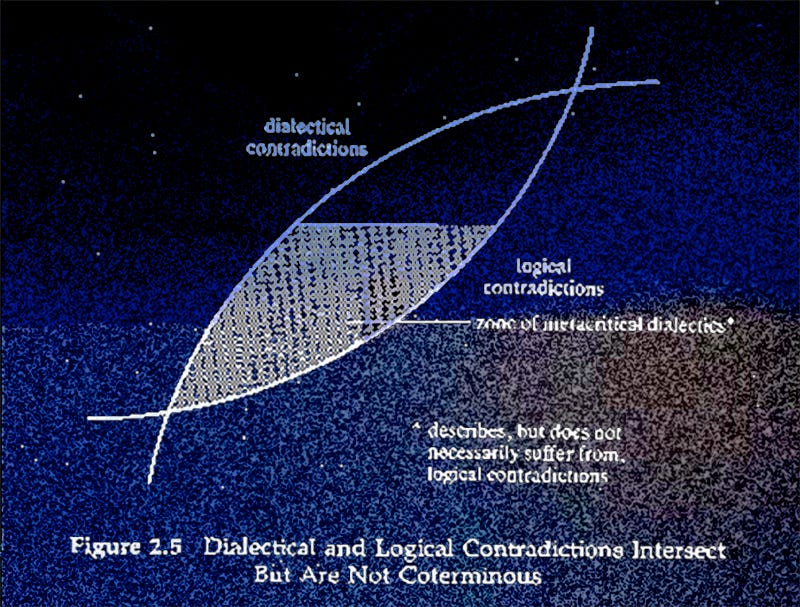
So what are the key contradictions here? Hegel, again in Science of Logic, provides a profound template with his analysis of Quality, Quantity, and Measure. He notes that things have qualities (defining characteristics) and quantities (amounts), and up to a point, quantitative change doesn’t alter quality. But once a critical threshold is passed, quantity turns into a new quality – water turns to ice when temperature drops enough, for example. Crucially, the unity of a certain quantitative range with a stable quality is what Hegel calls Measure. If the quantity goes out of that range, the measure breaks and a new quality emerges. This abstract idea is extraordinarily relevant for political economy. Consider money: it began as a measure of value (a unit for prices) and a medium of exchange. For a time, tying money to a commodity like gold provided a stable measure: a dollar or pound had a fixed gold content, anchoring its value. That was the “measure” in Hegel’s sense – the unity of quality (the currency’s trust and general acceptability) with quantity (the supply of money relative to gold). But capitalism’s dynamism kept pushing against this measure. The need for more liquidity, more credit, more money to fuel growth was boundless – Hegel, in a bout of speculation, might say money’s “quality” is to be measureless, to represent abstract social wealth with no intrinsic limit. Yet its quantitative embodiment (so many tons of gold, or so many paper notes convertible into gold) was limited. Money’s quantitative limit contradicted its qualitative ambition to represent infinite value. As Marx’s notes (and Choat further elaborates), “money’s measuredness contradicts its character, which must be oriented towards the measureless”. One could pose that this inner contradiction of money thus had to be overcome.
Marx describes exactly that in Grundrisse: the contradiction of money (as a finite quantity vs. universal wealth) is overcome in the form of capital. In capital, money sheds its limitation of being a static hoard and becomes “self-expanding”, at least nominally. As discussed in prior posts, some readers of Marx keep emphasising this self-inflating feature, and might interpret Marx’s above-linked comment as that this contradiction is overcome in capital, which is a form of value that increases itself, as in M–C–M′, money attains an ostensibly “measureless” quality: it seeks to grow without bound. Yet, contra Harvey once more, as Choat rightly points out “contradictions do not come to an end with capital.” (p.73) Every resolution in dialectics is also a new form of contradiction. Capital “resolves” the money contradiction by “putting money to work” (in production and via credit), but it introduces new tensions between, say, wages and profits, production and realization, use-value and exchange-value on a larger scale, etcetera; as Marx has elaborately pointed out.
Let’s illustrate this with the specific contradiction of wages and profit. Marx identified a long-run tendency: capitalists, in competition, strive to minimize labour costs, which tends to squeeze wages. But because labour is also the source of value (and workers’ spending is needed to realize that value), this creates a predicament – if wages are too low relative to output, who will buy the commodities? Marx discussed this as part of the falling rate of profit tendency and the possibility of crises of underconsumption or overproduction. In Volume III of Capital, he notes that if capital accumulates to the point where demand for labour is so high that wages rise, it would squeeze profits; conversely, if wages are depressed (either by unemployment or other means), it undermines the market for goods. There is an inherent contradiction: capital needs to employ and exploit labour, but the more it exploits (pays less), the more it imperils the realization of the very surplus it extracts. This can manifest as a tendency for the rate of profit to fall or periodic crises. Now, in the pre-1929 laissez-faire era, this contradiction played out in booms and busts and ultimately the cataclysm of the Depression.
Keynes’s intervention can be seen as a sublation of this contradiction in monetary form. Rather than letting the antagonism between wages and profits derail the system; deficit spending, rate setting, q.e. having a constant inflation as a goal (in modern times, a literal mandate) to boost spending. This is of course socially and politically easier than a direct wage cut. Monetary policy allows for a variety of Marx’s counteracting influences on the law the falling rate of profit, such as obviously depressing wages below the value of labour-power. If workers don’t get commensurate raises and prices rise, the share of output going to labour falls, shoring up profits, yet demand might be sustained by credit and government spending. This was essentially the story of the post-WWII “Golden Age” of capitalism: high demand and full employment, but creeping inflation that gradually redistributed some income from labour to capital, offset by rising productivity and an expanding welfare state. It seemed for a time that the contradiction had been managed.
On Value and Gold Post-’71
However, true to form, the resolution of one contradiction produces new ones. Fiat money and credit resolved the gold-money contradiction and, temporarily, the wages-profit squeeze (by fuelling demand and allowing modest inflation). But this gave rise to what we now call financialization, a new configuration full of its own contradictions. Here we see the relevance of Hegel’s conception of Measure again: the Keynesian era established a kind of measure between money and production – for a few decades, the increase in money supply roughly matched the growth of real output, and money was largely used to mobilize living labour (through industrial expansion, infrastructure, etc.). Money was reasonably well-anchored to the quality of productive activity, even without gold. But beyond a certain point – one could pinpoint the late 20th century, especially after the 1971 break and the 1980s – the quantitative expansion of money (credit) lost its qualitative link to productive value creation. The measure broke. The measure did not simply dissolve through internal contradiction alone; it broke because the United States, as issuer of the world’s reserve currency, began running structural trade deficits that threatened its monetary credibility.
1971 is a popular topic. See e.g., the website WTF Happened in 1971? Well, it wasn’t gold.
The severing of gold convertibility in 1971 marked not a new direction but a formal recognition that the rest of the world no longer trusted the U.S. to honour its monetary promises in gold. What replaced Bretton Woods was a set of foreign policy instruments designed to anchor global demand for dollars: petrodollar agreements and enforcements, and more importantly later on, the creation of a heavily financialised domestic economy that could absorb global surpluses. The U.S. stock market became the de facto global sink for capital as a mechanism of monetary hegemony. Foreign ownership of U.S. corporate equities has now reached over 40% according to most sources, with institutional investors among the largest holders – allocating reserves in dollars as opposed to Euros, not for trade settlement, but for asset appreciation. What this signals is a regime where surplus capital is not reinvested into production but continuously recycled into dollar-denominated claims on future value. It is money-capital no longer organising labour but being allocated to pursue a fictitious valuation.
As a sidenote, here I disagree with Marxists (or others) who insist on measuring real value in Gold-denomination. Though still popular with governments, it is nominally marginal, and with the current level of financialization price signals of gold are largely disconnected from any real barter trade, with most trade taking place through derivates. It is a derivative asset just like any other. At one point gold was a resemblance of a divine, static order which stored value – that is simply no more.
Continuing; through this development money capital flowed increasingly into speculation, asset bubbles, and (what Marx would call) dead labour: past products or fixed assets like real estate, and financial instruments that do not directly create anything of value. In the 2000s, for example, low interest rates led banks to extend massive credit for mortgage lending rather than financing new industrial enterprises. The result was rising house prices (an inflation of asset values) without a corresponding rise in productive output – in fact, industry stagnated and shrank, notably in the US. It is fine to employ the orthodox Marxist distinction between a use value and exchange value when noting that investing in existing property or financial assets does not add any new use-value, only exchange-value, but only when traded.
Keynes’s framework (and its contemporary children) struggle to account for this shift in money-capital allocation. The assumption that cheap money will translate into more employment and output relies on the existence of an actual the entrepreneurial economy, which is no more. We’ve seen the effects of this allocation into asset bubbles, inflated P/E ratios and extremely high concentrations of nominal capital. In effect, money as capital had become untethered from value creation.
We can say, in “Hegelian terms”, that the unity of quality and quantity in the monetary measure dissolved: thus, fiat money is no longer huge quantities of money capital yielded diminishing quality of real economic development. Gold does not really play a role here.
It’s intriguing that Keynes’s intuition foresaw the potential instability once money stops coordinating productive labour. In The General Theory, Keynes notably emphasized the role of expectations and uncertainty. Keynes advocated policies to keep money tied to productive uses: low interest rates to encourage enterprise rather than hoarding or speculative chasing of yield. In a sense, Keynes wanted money to serve as the Hegelian “measure” – the link between the quantitative aspect of investment and the qualitative aim of full employment and useful output, but as we have seen, such any measure is only stable within certain bounds.
So what now?
We might summarise the above as that value in the practice of an economy which produces, distributes, etcetera, is not a substance but a relation – one that synthesises disjointed labour into a measurable whole, historically constituted through money. Keynes, despite his liberal framing, grasped that such synthesis is temporal, unstable, and inseparable from the organisation of production. His most serious contribution was not a general theory of the economy but a refusal of static theories of value: in their place, a vision where value and distribution are co-constitutive. In a time when production is increasingly abstract – when intellectual property replaces machines, and financial claims outpace labour – it becomes necessary to return to Marx and Hegel, not for scholastic doctrine but for method.
Post Scriptum
There is an ongoing discussion (if I might read into recent comments by e.g. Jehu) whether the U.S. dollar is in fact a system in distress, or that the creditors are left holding the bag and that full dollarisation is the end game. I’m not sure on this – I can also see the reserve currency just change. It’s happened several times before, and I only understand the necessity for dollarisation as a solution to the current contradiction from the perspective of the U.S., but not for other powers. European countries would take a beating if they moved away from the dollar the most, but countries like China have peculiar systems in place where excess money is forcibly re-invested in new real estate and infrastructure as a means of generating revenue for local governments. In a way, instead of allocating superfluous money-capital to derivates and stocks, it is allocated to the physical land China. From this perspective I do not see the disaster if the dollar lost its reserve status.
Works cited or mentioned
Choat, Simon. Marx’s ‘Grundrisse’: A Reader’s Guide. London: Bloomsbury Academic, 2016.
Davanzati, Bernardo. A Discourse upon Coins. Translated by John Toland. London: A. and J. Churchill, 1696 [1588].
Eichengreen, Barry. Globalizing Capital: A History of the International Monetary System. 3rd ed. Princeton: Princeton University Press, 2019.
Hegel, Georg Wilhelm Friedrich. “The Doctrine of Being: Section One (Determinateness/Quality).” In The Science of Logic, translated by George di Giovanni. Cambridge: Cambridge University Press, 2010 [1812].
Jehu. The Real Movement [Blog].
https://therealmovement.wordpress.com/
Keynes, John Maynard. “The Choice of Units.” In The General Theory of Employment, Interest and Money. London: Macmillan, 1936. https://www.marxists.org/reference/subject/economics/keynes/general-theory/ch04.htm#:~:text=In%20dealing%20with,quantities%20of%20employment.
———. A Treatise on Money: The Pure Theory of Money. Vol. 1. London: Macmillan, 1930. http://tankona.free.fr/keynescw5.pdf#:~:text=Thus%20the%20age%20of%20money,chartalist.
Marx, Karl. “The Chapter on Money.” In Grundrisse: Foundations of the Critique of Political Economy, translated by Martin Nicolaus. New York: Penguin Books, 1973 [1857–61]. https://www.marxists.org/archive/marx/works/1857/grundrisse/ch03.htm.
———. “Chapter 20: Simple Reproduction.” In Capital: A Critique of Political Economy, Vol. II, translated by David Fernbach. New York: Penguin Classics, 1993 [1885]. https://www.marxists.org/archive/marx/works/1885-c2/ch20.htm.
———. “Chapter 13: The Law as Such.” In Capital: A Critique of Political Economy, Vol. III, translated by David Fernbach. New York: Penguin Classics, 1993 [1894]. https://www.marxists.org/archive/marx/works/1894-c3/ch13.htm.
Townshend, Hugh. “Liquidity Preference and the Theory of Interest and Money.” The Economic Journal 47, no. 185 (1937): 157–60.
Wray, L. Randall. Theories of Value and the Monetary Theory of Production. Working Paper No. 261. Annandale-on-Hudson, NY: Levy Economics Institute of Bard College, 1998. https://www.levyinstitute.org/pubs/wp261.pdf#:~:text=Because%20the%20majority,p.%20406).
WTF Happened In 1971?
https://wtfhappenedin1971.com
Where is Kalecki in all of this? The wayside because Keynes got the notoriety? --Brilliant series so far. Would like to see more engagement in the comments, but maybe we are just taking it all in.